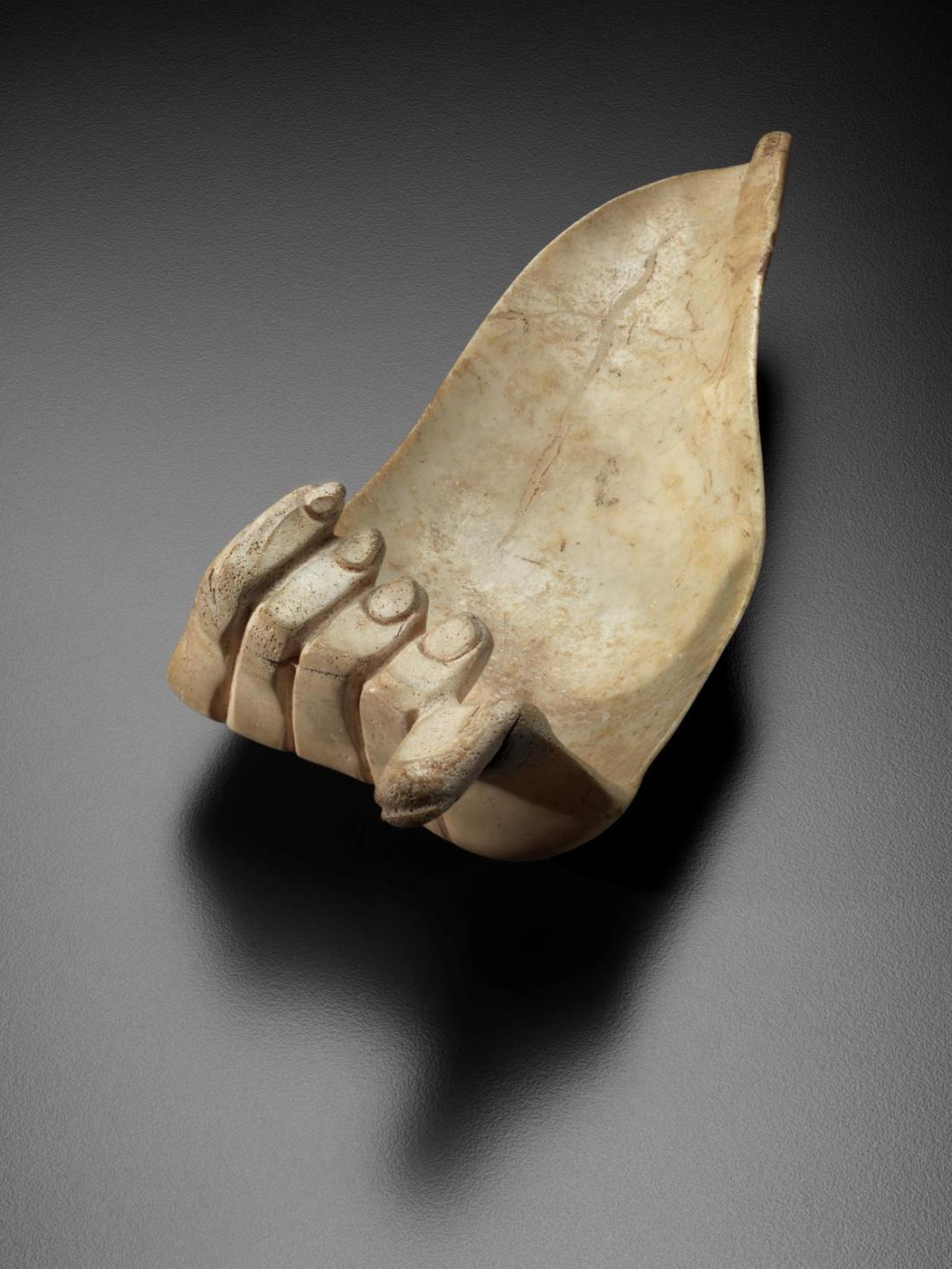
Palette for holding water-based paints carved from a large conch shell. The palette is carved asf the formal pose of Maya court painters portrayed on the pictorial ceramics, with fingers curled towards the palm and the thumb or forefinger pointing forwards.
#nationalsandwichday has us thinking about a key sandwich ingredient: bread. In this ancient #terracotta from the island of Cyprus, a woman is shown leaning over an oven to bake bread, throwing disks of dough onto the hot walls. Makers of terracotta figurines during this period often represented scenes from everyday life, sometimes placing the works in tombs to “remind” the dead of their activities in life. You can see this object and other archaic art from Cyprus in Gallery 174. ____ Terracotta woman baking bread, ca. 600–480 B.C. Cypriot. The Metropolitan Museum of Art, New York, The Cesnola Collection, Purchased by subscription, 1874–76 #themet-The Met
In the early 20th century, dealers who handled the ceramics from medieval Raqqa were tempted to cross the boundary between restoration and invention in order to convert unrelated fragments, or sherds, into something more saleable. This bowl for instance was mostly complete but was missing a large section of its rim.
A rim from a similarly shaped, but slightly smaller, bowl must have been broken into three pieces and expanded with paraffin wax in order to match the curvature of the larger bowl. Looking at the bowl in ultraviolet light, the wax glows a cool white.
In other cases the manipulation could be much more creative.
This is a small table, a low ceramic stand. When it first came into the collection it was thought to be more or less complete, although with a very unevenly preserved glaze. Above is an archival photo of the object, taken in 1986, documenting the object in its uncleaned state. This photo below is of the same side, after treatment. Cleaning revealed that the object had actually been cobbled together from nearly 100 fragments.
The diagram maps all the sherds that make up the object, previously concealed. Around one half to two thirds of the object is made from pieces of a single small table, although some of the pieces have been cut down or turned 90 degrees.
The pieces from the primary table are colored green, the remaining grey fragments come from at least one other object, more likely three or four others. An x-ray of the top face of the object reveals that a full half of it has been replaced with a ceramic tile featuring a completely different pattern.
The gaps were filled in with plaster. The entire object was covered in paint, with glass flakes and metal leaf used to imitate a badly degraded glaze. Even the interior of the object, invisible from the outside, was spackled and painted in order to hide the object’s true nature.
Often when pastiches like this are discovered in the collection they are disassembled in order to prevent others in the future from being fooled. In this case the configuration of the object was maintained, but the deceptive coatings were removed and the plaster was exposed to make clear what had taken place. Later viewers will be able to appreciate the history of the piece, foregrounding the events which befell it in the early 20th century, without the risk that it might be mistakenly thought of as a complete, medieval object.




 mysong5